

Our team lives on Koh Phi Phi, so we are not Bangkok locals. We plan Bangkok trips for our island guests and we work with Thai guides we book directly in the capital. Chinatown is one of the stops we send almost everyone to, because it is the part of the city that still feels like old Bangkok: gold shops, incense smoke, Chinese signage stacked above Thai signage, and a street food scene that takes over the main road after dark.
This guide is a walk-through of the area on foot. No stalls named, no restaurants starred: just the streets, the lanes, the temples and the right time of day for each. Names of shops change. The map does not.


Bangkok's Chinatown in one paragraph
Chinatown sits just west of the old royal city, wedged between Hua Lamphong train station and the Chao Phraya river. The spine is Yaowarat Road, a long curved street packed with gold shops, apothecaries, Chinese bakeries and, after sunset, street food carts. Running parallel to the south is Charoen Krung, one of Bangkok's historic thoroughfares, and tucked between the two is the Sampeng lane, a narrow wholesale market alley that has been trading for generations.
The two anchor temples are Wat Traimit at the eastern gateway and Wat Mangkon on Charoen Krung. You can walk the whole thing end to end fairly quickly if you do not stop. You will stop.
Yaowarat Road: the main artery
Yaowarat is the street in every photo of Bangkok Chinatown. Wide by local standards, curved, and flanked by taller shophouses than the surrounding grid. By daylight it is a working business street: gold dealers in red and gold storefronts, dried seafood shops, herbalists, roast duck windows and old coffee houses hidden behind glass doors.

After dark, parts of the road and the small sois branching off it fill with food carts, plastic stools and smoke. The famous neon is real but concentrated: it looks its best near the main intersection, after the shops roll down their shutters.
A warning for photographers: Yaowarat is a live road with traffic, tuk tuks and delivery bikes. Do not stand in the middle for the shot. Our first-timer street food guide covers how we think about queueing and ordering here without making a mess of it.
Sampeng and the side lanes
Parallel to Yaowarat, one block south, runs Sampeng Lane (Soi Wanit 1). It is a narrow, covered wholesale market where traders have sold fabric, hair clips, toys, kitchenware and knock-off everything for generations. It is not a place for a relaxed stroll: expect motorbikes threading through the crowd, boxes on trolleys, and shoulders.
Still, we send curious walkers in on purpose. Sampeng is where you feel how old the neighbourhood is and how commercial it still is. It is best in the late morning, when the market is fully open but the midday heat has not peaked.
Around Sampeng, small perpendicular alleys lead off to Soi Issaranuphap, the fresh market lane that runs north from Charoen Krung into the heart of the quarter, lined with butchers, dried goods, and ritual paper offerings during Chinese festivals.
Wat Traimit: the eastern gateway
At the eastern end of Yaowarat, where the Odeon arch marks the entrance, sits Wat Traimit. The temple is famous for its large solid gold Buddha image, long hidden under plaster and rediscovered by accident. The hall that houses it is modern, raised on top of a small museum about Chinatown's history and the Chinese immigration to Bangkok.
As a visitor, dress as you would for any Thai temple: covered shoulders, covered knees, shoes off at the hall. This is a working temple, not just a photo stop.
It pairs naturally with a half-day of temples along the river. If that is your plan, the Grand Palace and temples route can finish here or start here, depending on where your guide picks you up.

Wat Mangkon and the Chinese temples
Walking west along Charoen Krung, you reach Wat Mangkon Kamalawat, a major Chinese Mahayana temple in the quarter. It is a working temple, loud with chanting during festivals, thick with incense most days. Expect several courtyards, ancestor halls and bright red and gold detailing that feels very different from the Thai Theravada temples in the rest of the city.
Smaller shrines and clan temples are dotted all around the grid. You will stumble into them if you take the small lanes instead of the main roads. Several are dedicated to specific Chinese guilds and are still used by the families who built them.
Around Chinese New Year and the vegetarian festival these temples go into overdrive. Dates move every year with the lunar calendar: check this year's dates before you plan around them.
Day versus night: almost two different neighbourhoods
Day Chinatown and night Chinatown are not the same place. We plan them as two visits if we can.
The daytime version is about temples, the wholesale market, the gold shops with their doors open, old coffee houses, and the tight back lanes. Come between mid-morning and early afternoon. The light in the alleys is beautiful and the markets are fully stocked.
The night version is about the food scene on Yaowarat. Carts set up as the gold shops close. Plastic stools spill onto the pavement. The neon comes on. Come after dark and be ready for crowds, especially on Friday and Saturday, and especially in high season.
If you only have one visit in you, we would choose the evening for atmosphere. A night tuk tuk circuit through Chinatown and nearby landmarks is the easy way to see the lit-up version without planning the logistics yourself.

How to arrive: MRT, river boat or tuk tuk
The easiest way in is the MRT Blue Line. Wat Mangkon station drops you a short walk from the temple that gives it its name, right in the middle of the action. Hua Lamphong station is the other end, close to Wat Traimit, and makes a natural start point if you want to walk east to west.
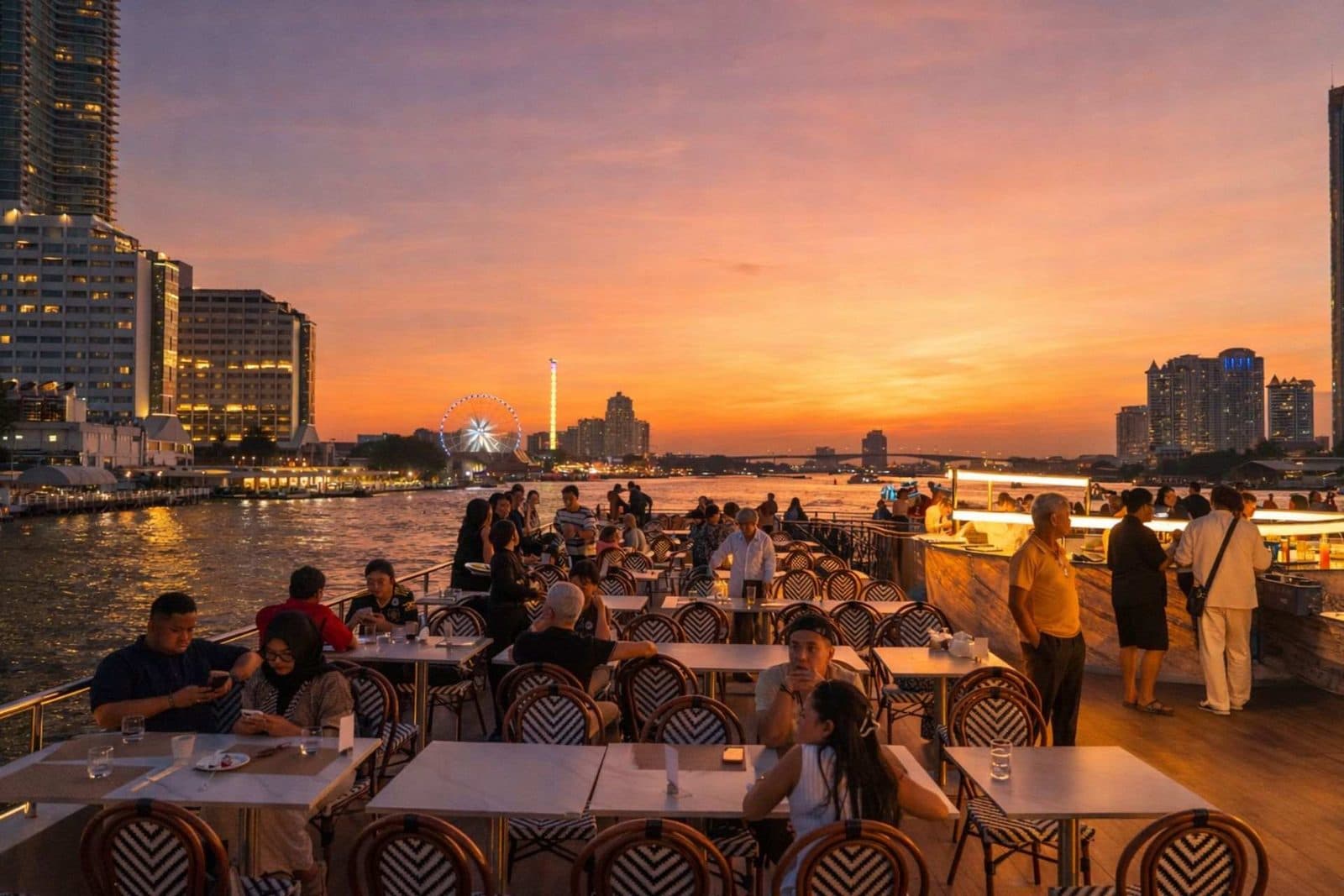
From the river, take a Chao Phraya Express Boat to the Ratchawong pier. From there it is a short walk north into Sampeng and up to Yaowarat. Combining Chinatown with a late afternoon river ride works well, and a sunset cruise is a good way to wind down afterwards.
Tuk tuks and metered taxis will of course drop you here. Agree on the tuk tuk price before you get in, every time. For Chinatown specifically, the MRT is usually faster than road traffic at rush hour.
A walking route we suggest
A simple loop we give our guests, with no stops named:
- Arrive by MRT at Hua Lamphong. Walk to Wat Traimit and climb up to see the golden Buddha.
- Head west under the Odeon arch and start down Yaowarat in daylight. Dip into the first few sois for a sense of the grid.
- Cut south to Soi Issaranuphap and the fresh market, then connect to Sampeng Lane and walk it for as long as you can stand the crowds.
- Pop back up to Charoen Krung and visit Wat Mangkon.
- Exit via Wat Mangkon MRT, or push on to the river at Ratchawong pier.
- If you can, return the same evening to walk Yaowarat with the lights on.
For a food-forward version with a guide handling the carts, the street food tuk tuk tour is a good option.
Who Chinatown is (and is not) for
It is for travellers who like dense, noisy, slightly chaotic city neighbourhoods and are curious about food, history and small details. It rewards walking slowly and looking up at the shophouse facades.
It is not the best choice if you need quiet, wide pavements, step-free routes or a stroller-friendly path. The pavements are broken in places, the lanes are narrow, and night Yaowarat is shoulder to shoulder. Travellers with heat sensitivity should come at the end of the day, not at noon.
If you want to see where it fits in a wider trip, our Bangkok shortlist and the three day plan both slot Chinatown in as a full evening, often paired with a daytime temple route.
Practical notes before you go
A few things we repeat to every guest:
- Carry small cash. Many stalls and tiny shops do not take cards.
- Dress for temples even if the temples are not your first stop: covered shoulders and knees means you can walk into any of them.
- Watch your bag in crowded lanes, as in any busy market.
- Ignore any stranger who tells you a temple is "closed today" and offers to take you elsewhere. Walk to the gate yourself.
- The neighbourhood is walkable from Hua Lamphong to the river, but add rest stops. The heat is real year round.
For the rest of the capital, our Bangkok destination page lists the other areas we cover and the day trips we can book around them.